
LEICA SL (Typ 601)
The Future One look is enough
The Future One look is enough
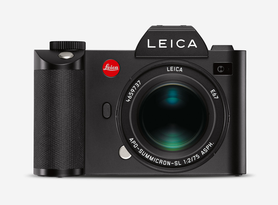
The Leica SL-System is the embodiment of the digital era in professional photography. As a mirrorless system camera with an electronic viewfinder and electronic shutter, the Leica SL impresses with versatility, ease of handling and robustness.
Its versatility is underlined by its maximized compatibility with lenses from other Leica systems. Discover the power of the moment. Discover the Leica SL-System.
Groundbreaking Technology
Due to its exceptionally high resolution and imperceptible latency time, the EyeRes viewfinder developed especially for the Leica SL could well be mistaken for an optical finder. It does, however, offer all the advantages of an electronic viewfinder: Furthermore, the Leica SL also has the fastest autofocus of all professional cameras – including DSLRs.
Impressive Performance
With its 24-megapixel full-frame CMOS sensor, the Leica SL guarantees excellent picture quality – even in the most difficult situations. The ISO sensitivity value can, for instance, be set to a maximum of 50,000. Its Maestro II series processor enables continuous shooting at up to 11 frames per second with full 24-megapixel resolution.
Conceived for the Daily Rigours of Professional Use
The Leica SL has everything to meet the rigorous demands of professional photographers. A dust- and splash-proof chassis machined from solid aluminum. Logical ergonomic design. Maximum compatibility with other systems. And the ability to fit seamlessly into modern photographic work environments.
Groundbreaking Technology

Speed
Mirrorless
Imaging quality, speed, and extremely rugged resilience: with record values in all areas, the mirrorless Leica SL finally puts an end to the need for traditional single lens reflex technology. In fact, it delivers conclusive proof that the mirrorless, full-frame camera is the technology of the future.
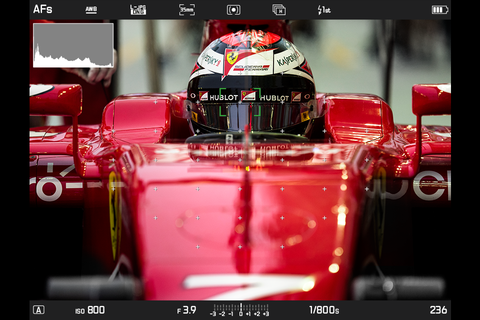
The light coming through the lens falls directly on the sensor, which delivers an uninterrupted live image to the electronic viewfinder. This live image takes all camera settings and exposure parameters into account and, if desired, also displays additional information. The viewfinder displays 100% of the subject. The image in the EyeRes viewfinder can be magnified, for instance, to assess sharpness and subject details.
In contrast to an SLR camera, the scene remains visible in the viewfinder during video recording.
The viewfinder image always remains bright and clear no matter how fast the lens may be. The view also stays bright when stopping down and makes assessing depth of focus much better and easier than with an SLR.
As the capture format of the sensor can be changed electronically, even lenses that do not cover the entire image circle generate a full-size viewfinder image.
As there is no mirror and prism assembly, the camera can be slimmer and more compact. For example, viewed from side, the Leica SL is only 35 mm thick.
As the complex mechanisms of an SLR are no longer required, the Leica SL is less prone to mechanical failures. As there is no mirror slap, it is also much quieter in use.
Thanks to its short register, many different lenses can be mounted with appropriate adapters – even lenses for cinematography.
The EyeRes Viewfinder
The next generation of viewfinder technology
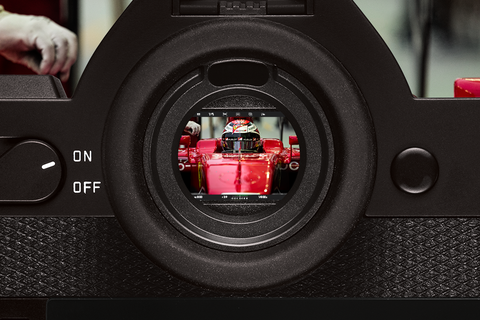
The Leica SL is the world’s first camera conceived for professional photography to feature an electronic viewfinder. With a latency time below the threshold of perception and a resolution of 4.4 million pixels, this EyeRes viewfinder developed especially for the Leica SL offers an entirely new visual experience. As its image can be electronically brightened, the EyeRes viewfinder is superior to optical viewfinders in low or unfavorable light.
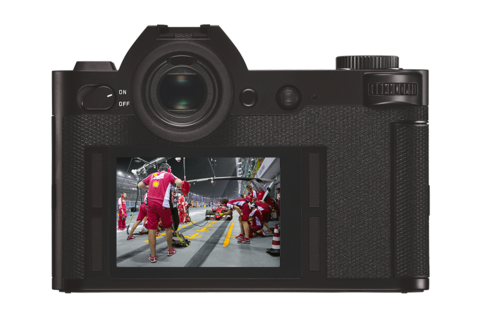
It also offers all the options and features that only an electronic viewfinder can. For instance, the viewfinder, with a size that is reminiscent of medium-format cameras, shows you how your final picture will look. The effects of all decisive parameters like exposure, depth of focus, and white balance are simulated and can thus be assessed before pressing the shutter release. Electronic functions like a dual-axis levelling aid, various grids, or Focus Peaking can be displayed in the electronic viewfinder to help you get the very best from your subjects. The Leica SL meets your professional video recording requirements with a zebra function for avoiding overexposure that can be added to the viewfinder image. The EyeRes viewfinder is activated in the simplest possible way – by looking through it. An integrated sensor switches it on and off to prevent unnecessary battery drain.
High-Speed Autofocus
Faster than any SLR system
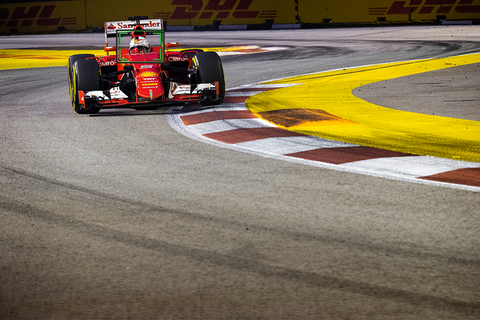
Capturing exactly the right moment is not only essential in sport photography. When used together with the Vario-Elmarit–SL 24–90 mm f/2.8–4 ASPH. and the Leica APO-Vario-Elmarit-SL 90–280 mm f/2.8-4 zoom lenses, the Leica SL has one of the fastest autofocus systems of all professional cameras – including SLRs. The camera moves the focus from infinity to the closest focusing distance in less than 110 milliseconds.
The telephoto zoom features double internal focusing (DSD™), in which two lens elements move towards each other. This enables very fast and almost-silent autofocus and consistently high imaging performance from infinity to its closest focusing distance.
Of course, the Leica SL offers you a choice of AF-C or AF-S, depending on your subject, and the ability to switch from autofocus to manual focus using the ring on the lens at any time. The Leica SL controls focusing with exceptional speed and precision on the basis of up to 529 AF focusing segments. For detailed work, the camera also offers the ability to set a single AF focusing point. Focusing can be set either by a simple tap on the touch screen on the part of the subject you wish to focus on, or automatically, by enabling the eye detection function. Here, the Leica SL focuses sharply on the eye that is closest to the camera. Another useful aid, also when shooting video, is subject tracking. Here, when a particular object is marked with a focusing point, the focus is held on this object and follows its movement.
4K Video
For moving and moving pictures
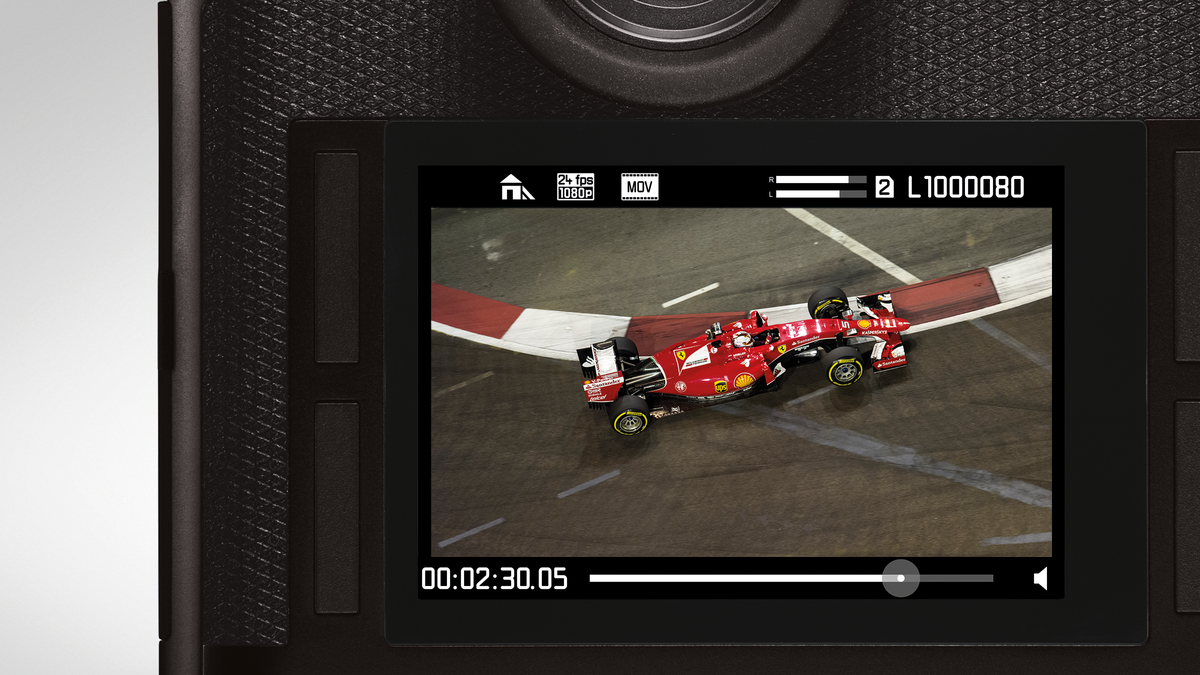
The Leica SL is much more than a professional still-picture camera with video recording capability: it fulfills even the most stringent demands of moviemakers as a fully fledged video camera. This begins with a clear and simple handling concept that clearly separates still and motion picture functions and ends with HDMI 1.4 output. This allows professional videos to be output in 4:2:2 10-bit format with 4K cine resolution and the production of professional videos in combination with an HDMI recorder. As soon as the Leica SL is in video mode, the display shows only relevant information for video recording, such as safe area, aspect ratio, zebra function, or the recording level of the microphone. As you would expect from professional equipment, the exposure is always displayed as it is during recording. An optional audio adapter allows you to connect an off-camera microphone and the audio recording level can be set without accessing the menu. As when using the Leica SL for still pictures, you can also depend on the excellent quality of motion picture recordings and enjoy almost infinite creative freedom. In combination with the excellent Leica Summilux and Summicron Cine lenses, and by working with 4K resolution in Super 35 format, you gain access to possibilities that were otherwise known only to professionals in the production of movies for the motion-picture industry.
Convincing Performance
Maestro II Processor
Instantaneous response in every situation
Instantaneous response in every situation
The exceptional speed of the Leica SL is down to the use of a Maestro II series high-performance processor. Thanks to this processor, the Leica SL achieves absolutely the best performance currently possible in the professional camera class and underlines the groundbreaking character of the camera. The Maestro II processor ensures that the camera responds instantaneously to every command. Every time.
Together with 2 GB of buffer memory, the processor makes it possible to capture consecutive exposures at rates of up to 11 frames per second with full 24-megapixel resolution and 4K video with a frame rate of 30 frames per second. Still pictures can be saved simultaneously in both JPEG and DNG format to an SD memory card by virtue of the fast UHS II standard.
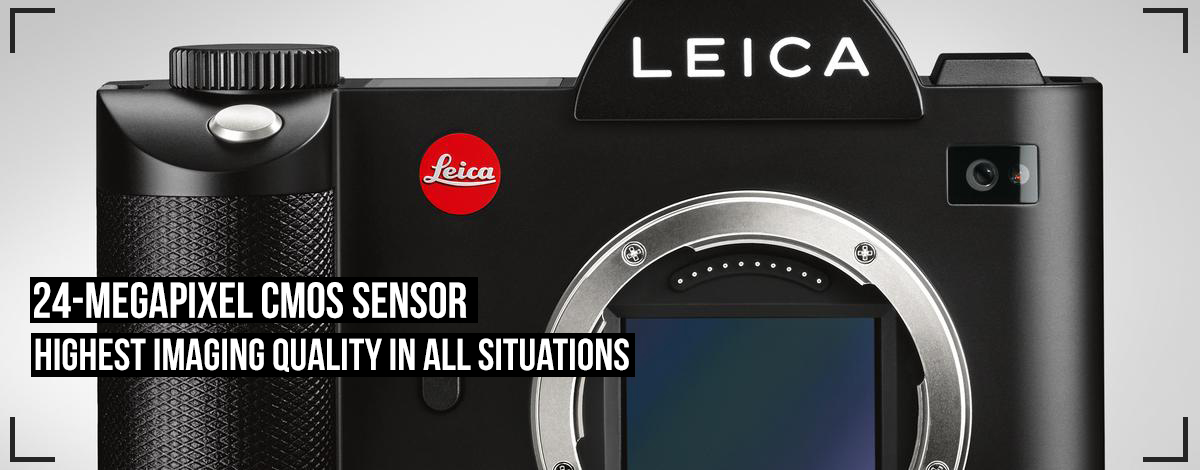
24-Megapixel CMOS Sensor
Highest imaging quality in all situations
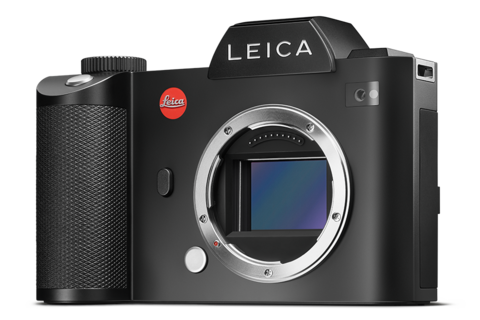
The sensor of the Leica SL has 4000 × 6000 pixels with a pixel pitch of 6 × 6 µm on an active surface area with dimensions of 24 × 36 mm2. This means that you can depend on the imaging quality of a 35 mm, full-frame format. To ensure maximum image sharpness, Leica has intentionally left out the low-pass filter. At the same time, a specially designed pixel architecture ensures that more light falls on each individual photodiode. The result is impressive dynamic range, excellent contrast rendition, exceptional sharpness, the highest resolution, and noise-free images in almost all lighting conditions.
Particularly in available-light situations, the interplay of the sensor with the Leica SL lenses reveals its full potential and captivates with atmospheric images of superior quality at ISO values of up to 50000. The sensor also plays a key role in terms of the compatibility of the Leica SL-System. For instance, it is optimized for use with Leica M-Lenses and, in addition to supporting all functions, delivers a picture quality that can be achieved only by Leica cameras.
Conceived for the Daily Rigours of Professional Use
Controls and Handling
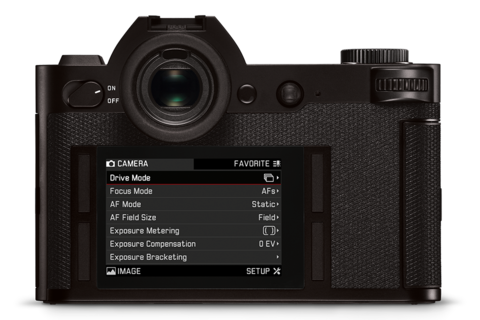
Intuitive handling, held with ease
The sensor of the Leica SL has 4000 × 6000 pixels with a pixel pitch of 6 × 6 µm on an active surface area with dimensions of 24 × 36 mm2. This means that you can depend on the imaging quality of a 35 mm, full-frame format. To ensure maximum image sharpness, Leica has intentionally left out the low-pass filter. At the same time, a specially designed pixel architecture ensures that more light falls on each individual photodiode. The result is impressive dynamic range, excellent contrast rendition, exceptional sharpness, the highest resolution, and noise-free images in almost all lighting conditions.
Particularly in available-light situations, the interplay of the sensor with the Leica SL lenses reveals its full potential and captivates with atmospheric images of superior quality at ISO values of up to 50000. The sensor also plays a key role in terms of the compatibility of the Leica SL-System. For instance, it is optimized for use with Leica M-Lenses and, in addition to supporting all functions, delivers a picture quality that can be achieved only by Leica cameras.
Rugged and Resilient
Perfectly engineered – takes everything in its stride
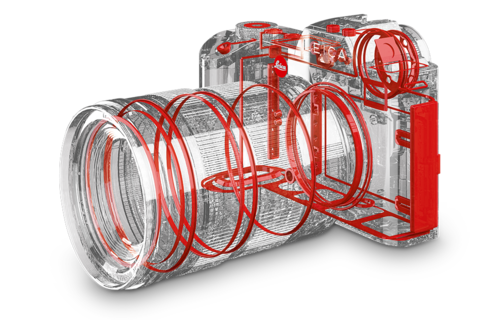
The Leica SL was conceived to fulfill the special needs of everyday professional photography. From the elaborate construction with the finest materials to the precise finishing of all its components. Its chassis, machined from a block of solid aluminum, weighs only 847 g and offers perfect protection for the sensitive components inside the camera. The use of numerous seals in the camera body, its control elements, and the Leica SL-Lenses makes it virtually impossible for dust, moisture, or water to get inside.
Specially hardened front glasses with AquaDura® coating protect the lenses against dirt, dust, and moisture. The results can be viewed through the extremely scratch-resistant and anti-reflex coated real glass cover of the back panel display. The special feature here is that the cover glass and the LCD panel form a single entity – with no gaps that could let dust or dirt get inside.
Maximum Compatibility
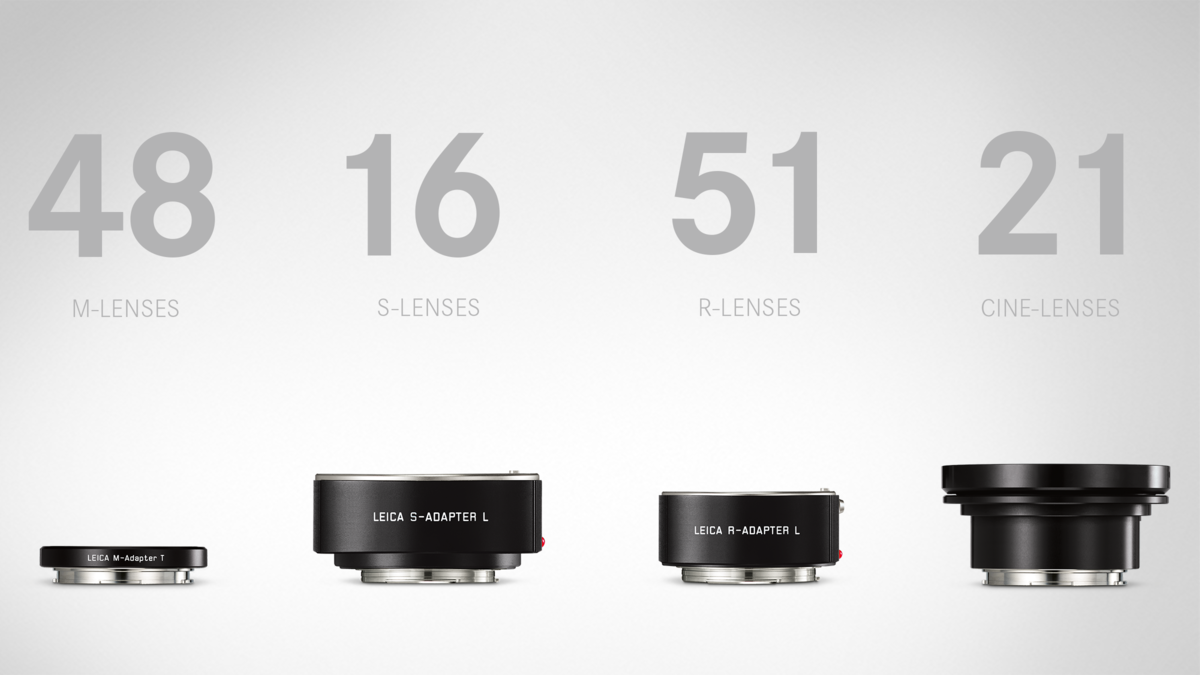
Photography with more than 100 Leica lenses
With the Leica SL, the choice of lenses you can use is almost limitless. In addition to the lenses of the SL-System, Leica T/TL mount lenses can also be mounted on the camera without an adapter. Dedicated adapters provide access to many other excellent lenses from past and present Leica systems.
For instance, you can take unlimited advantage of the exceptional performance of Leica S- and M-Lenses. In the case of Leica M-Lenses, 6-bit coding preserves all functions, such as exposure metering, automatic aperture priority exposure, and manual setting, to their full extent. Thanks to the Leica R-Adapter L, even the extensive range of proven R-Lenses can be used on the Leica SL.
Seamless Integration
Fits perfectly into your working environment
The Leica SL is designed and constructed for seamless integration into existing working environments and work flows. Image data can be saved in the future-proof DNG (Digital Negative) format, the only manufacturer-independent, standardised format that does not rely on dedicated RAW converters. USB 3.0 enables fast and stable tethered shooting with the camera connected to a computer.
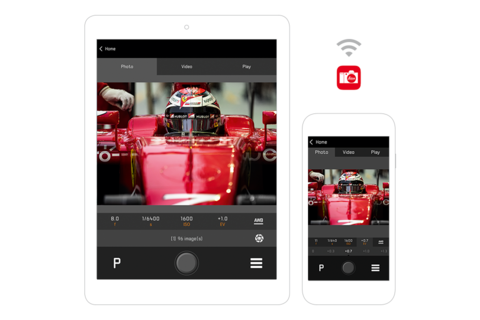
Leica Image Shuttle software ensures an efficient work flow and enables all relevant exposure parameters such as shutter speed and aperture to be assessed on the monitor of a PC. The Leica SL App enables remote control of the camera and the use of a smartphone or tablet as a monitor screen.
| Lenses | |
|---|---|
| Lens Mount | Leica L-Mount |
| Applicable lenses | Leica Vario-Elmarit-SL 24–90 mm f/2.8–4 ASPH. |
| Leica APO-Vario-Elmarit-SL 90–280 mm f/2.8–4 | |
| Leica Summilux-SL 50 mm f/1.4 ASPH. | |
| Lenses from the Leica T Camera System, Leica M-Lenses with Leica M-Adapter T, Leica S-Lenses with Leica S-Adapter L, Leica R-Lenses with Leica R-Adapter L and Leica Cine lenses with Leica PL-Adapter L. | |
| Sensor | |
| Type | 24-MP-CMOS-Sensor (24 × 36 mm) |
| Resolution | Full Frame (24 MP): 6000 × 4000 Pixel, APS-C (10 MP): 3936 × 2624 Pixel |
| Filter | IR-Filter, no Lowpass Filter |
| ISO | ISO 50–ISO 50000 |
| Sensor Cleaning | Provided |
| Processor | |
| Type | Leica Maestro II series |
| Internal RAM | 2 GB: 33 DNGs or 30 JPEGs and DNGs |
| Image | |
| Image Data Format | JPEG, DNG |
| Colordepth | 14 bit (DNG), 8 bit (JPEG) |
| JPEG Color Space | Adobe RGB, ECI RGB, sRGB |
| Motion | |
| File Format | MP4, MOV |
| Resolution | 4K (4096 × 2160) @ 24 fps; 4K (3840 × 2160) @ 25 and 30 fps; 1080 @ 24, 25, 30, 50, 60, 100 and 120 fps; 720 @ 24, 25, 30, 50, 60, 100 and 120 fps |
| Bitrate | 8 bit (recording); 10 bit (HDMI not recording) |
| Color sampling | 4:2:2/10 bit (HDMI only); 4:2:0/8 bit (recording on SD card) |
| Video | L-Log selectable |
| Audio | Manual/Auto; Stereo microphone, 48 kHz, 16 bit; Wind elimination |
| Audio external via Audio-Adapter | Audio-In (3.5 mm phone jack), Audio-Out (3.5 mm phone jack) |
| Movie Length | Max. duration: 29 min, Max. size: 4 GB |
| EVF | |
| Resolution | SXAG, 4.4 MP |
| Size | 0.66" |
| Eye Point | 20 mm |
| Field of View | 37° |
| Magnification | × 0.80 (with 50 mm lens at infinity, −1 dpt) |
| Frame coverage | 1 |
| Diopter correction | − 4 to +2 |
| Eye Sensor | Yes |
| Live View | Operating Modes: Video- and Photo-Live-View separated; Frame rate: up to 60 fps; Exposure simulation available, Optional information: Focus Peaking, Histogram, Clipping/Zebra, Level, Grid Overlay (3 × 3, 6 × 4), Aspect Ratio (1.33:1; 1.66:1; 1.78:1; 1.85:1; 2.35:1; 2.4:1), Safe Area (80 %; 90 %; 92.5 %; 95 %) |
| Storage | SD 1 slot (UHS II) with maximum writing speed 100 MB/s, SD 2 slot (UHS I) with maximum writing speed 30 MB/s |
| SD memory cards compatibility: | |
| UHS-1: | |
| All UHS-1 SD cards | |
| UHS-2: | |
| TOSHIBA EXCERIA PRO SDXU-B016G [16GB] | |
| TOSHIBA EXCERIA PRO SDXU-B032G [32GB] | |
| TOSHIBA EXCERIA PRO SDXU-B064G [64GB] | |
| TOSHIBA EXCERIA PRO SDXU-B128G [128GB] | |
| Focussing | |
| Type | Contrast AF |
| Focus Modes | AF-S (focus priority), AF-C (shutter priority), MF, Touch-AF |
| AF Modes | Static, Dynamic (tracking), Auto (face detection) |
| AF Size | Point, Field, Zone (9 Fields) |
| AF Steps | 37 or 49 Fields |
| AF Assist Lamp | Built in |
| Exposure | |
| Exposure Modes | Program Mode (P), Shutter speed priority mode (T) , Aperture priority mode (A) and manual mode (M) |
| Exposure Metering Modes | Center weighted, Multi zone, Spot |
| Exposure Compensation | ±3 EV in 1/3 or 1/2 EV-steps |
| Exposure Bracketing | 3/5/7 images in 1/2/3 aperture steps; additional direct JPEG-HDR |
| White Balance | Preset Auto, Daylight 5200 K, Cloudy 6000 K, Shade 7000 K, Tungsten 3200 K, HMI 5600 K, Fluorescent warm 4000 K, Fluorescent cool 4500 K, Flash 5400 K, Greycard, Manual color temperature 2000 K to 11500 K |
| Type | Focal plain shutter |
| Drive Modes | Single, Continuous slow S (4 fps), Continuous medium M (7 fps), Continuous fast F (11 fps), Self timer 2 s, Self timer 12 s, Interval, Exposure Bracketing, Time exposures up to 30 min |
| Shutter speed | 1/8000 s to 60 s, time exposures up to 30 min, Max. frame rate 11 fps, |
| Flash | |
| Interface | Standard X-jack, Hot shoe with Sync. and TTL-Mode contacts |
| X-Synchronization | 1/250 s |
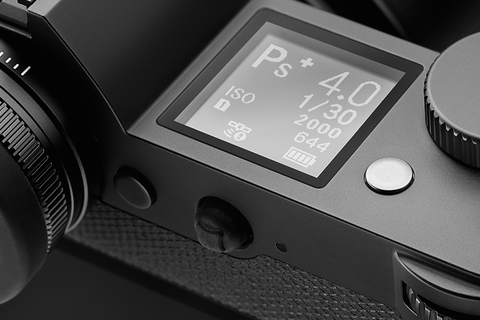
| Top Display | 1.28" highly reflective monochrome LCD; 128 × 128 dots; View angle 120°; Anti-fingerprint coating |
| Housing | |
| Material | Milled Aluminium |
| Dust/Spray water sealing | Provided |
| Interfaces | USB 3.0 Micro Type B; HDMI Type A; Multi connector adapter for Audio-Out 3.5 mm/Audio-In 3.5 mm; Multi connector cable release; ISO accessory shoe with center and control contacts for flash units; Standard X-jack; Multifunctional interface in baseplate for optional handgrip |
| Tripod threat | A 1/4 DIN 4503 (1/4") with anti-twist locking pin |
| Dimensions/Weight | 147 × 104 × 39 mm (W × H × D)/approx. 771/847 g (without/with battery) |
| Working conditions | Approx. 0°– 40 °C, max. 85 % humidity |
| Scope of delivery | Camera body, Camera strap, Lens mount cap, Battery, Battery Charger with international adapter, USB 3.0-cable, Manual, Warranty Card, Leica Lens cleaning tissue |
| Software | Remote Control (USB): Leica Image Shuttle SL; Remote Control (Wi-Fi): Leica SL app (Android/iOS) |